Governance
Corporate Governance
Corporate Governance System
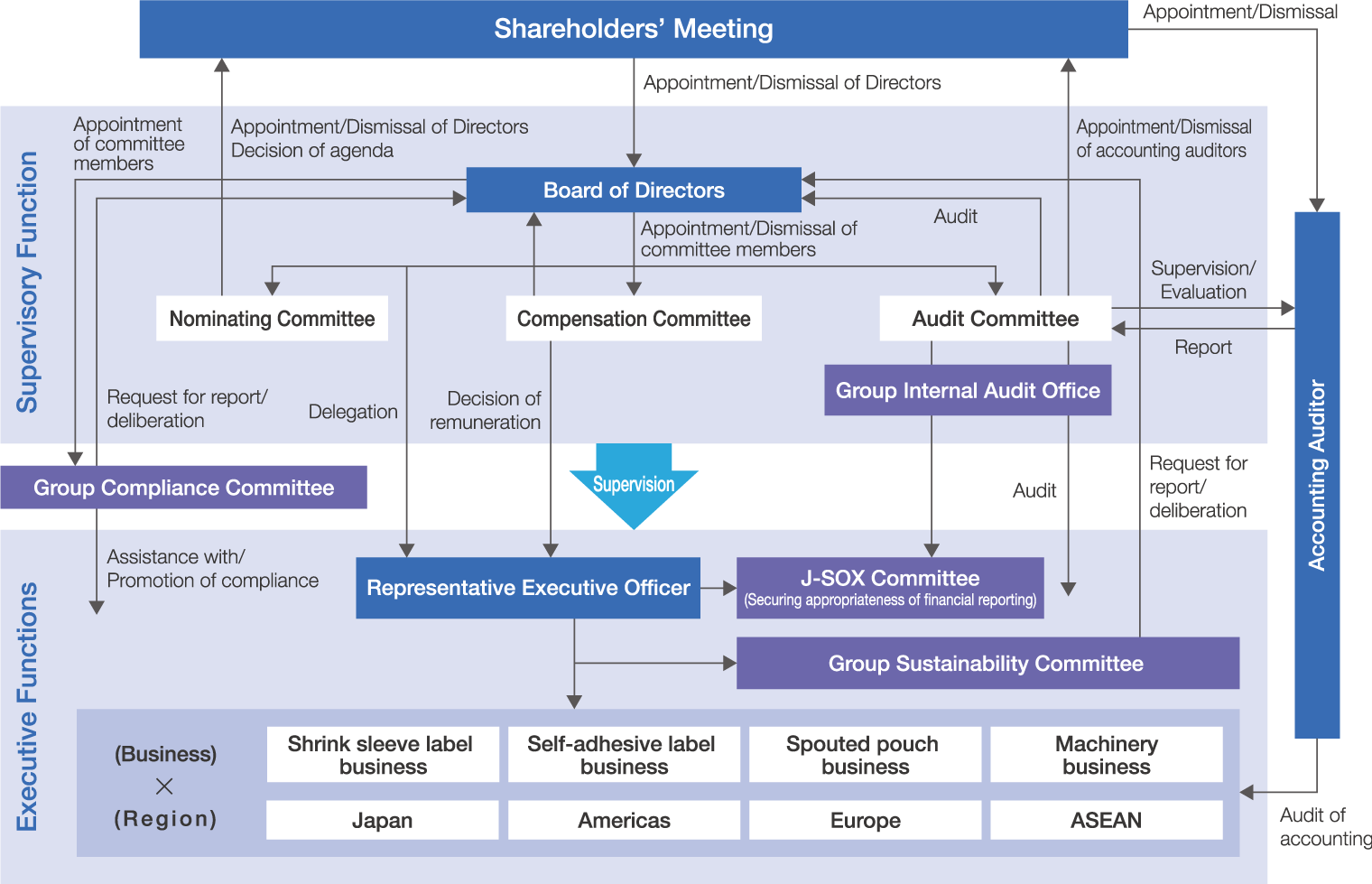
FSG transitioned to a Nominating Committee, etc. (then, a "Company with Committees") in June 2004, and has continued to strengthen its corporate governance system. Under the Board of Directors, the Company has established the Nominating Committee, the Remuneration Committee, and the Audit Committee, each of which is composed of a majority of outside directors, in order to enhance management oversight functions and improve transparency.
The Company clearly separates the supervision of management from the execution of business operations. Specifically, this framework aims to:
- (1) Strengthen corporate governance throughout the Group;
- (2) Improve management transparency for shareholders and investors;
- (3) Clarify the roles of Group management and business execution at each Group company, while enhancing the efficiency and quality of Group strategy; and
- (4) Diversify management perspectives by utilizing the expertise of outside directors and strengthen the Group's ability to respond to change.
The Nominating Committee deliberates on and resolves matters related to the appointment of directors and executive officers. In addition, from the perspectives of enhancing Group management and developing next-generation talent, the Committee also deliberates on and submits proposals regarding the nomination of officers of Group companies.
The Remuneration Committee determines the remuneration of directors and executive officers in accordance with the Basic Policy on Remuneration. From the perspective of strengthening Group governance, the Committee also deliberates on and determines the remuneration of officers of Group companies.
The Audit Committee consists of three outside directors, and has been established to ensure that the Group's operations are conducted lawfully, appropriately, and efficiently, in accordance with its annual policies and medium- to long-term management policies.
Structure of the Board of Directors
The Board of Directors consists of six directors, including three independent outside directors, with due consideration
given to ensuring expertise and diversity. Internal directors possess broad practical experience, including knowledge of overall management such as management strategy, as well as experience as heads of Group operating companies and
in managing overseas businesses. Outside directors include professionals with high levels of expertise and insight in their respective fields, such as attorneys, certified public accountants, individuals with experience in safety, disaster prevention and manufacturing in the field of technology development, and executives of listed companies. Through the appointment of such personnel, the Company seeks to strengthen its supervisory function from an independent standpoint.
While one of the six directors is female and all the directors are Japanese nationals, the Board possesses diverse knowledge, experience and capabilities across a wide range of fields, including overseas business operations, thereby contributing to an effective governance structure.
Assessment of board effectiveness
The Company works to strengthen corporate governance and ensure the effectiveness of the Board of Directors through the evaluation and supervision of directors and executive officers by the Nominating, Audit and Remuneration Committees, as well as through the annual assessment of Board effectiveness.
In FY2025, the Company selected themes with reference to the Guidance for Collaborative Value Creation 2.0, and held discussions in March 2026 based on the results of a non-anonymous questionnaire completed by all directors. The use of a non-anonymous questionnaire helped promote shared understanding among the directors, clarify priority issues, and facilitate more focused discussions on concrete measures.
As a result, the Board identified the following priority issues: (1) responding to market changes and strengthening competitiveness; (2) strengthening the financial base and promoting management with greater awareness of capital costs and share price; (3) advancing DX initiatives; (4) enhancing risk management; (5) reviewing executive skills in response to changes in the business environment; and (6) strengthening succession planning. Based on these findings, the Company will further improve the quality of Board discussions by enhancing decision-making and monitoring processes, while promoting the practical development of next-generation management candidates through participation in key meetings and other initiatives.
The Company will continue to reflect the issues identified through the effectiveness assessment in the deliberations and operation of the Board in the following fiscal year, and will strive for continuous improvement.
Remuneration of directors and executive officers
The Company has established a Remuneration Committee to ensure transparency in the management of the Group.
To maintain transparency and independence, the Remuneration Committee consists of four members: three outside directors and one internal director.
The Remuneration Committee mainly determines the policy for decisions on individual remuneration, etc. for directors and executive officers, the details of individual remuneration, etc. for directors and executive officers, and the evaluation of company-wide performance targets and individual performance targets for each executive officer in relation to performance-linked remuneration for executive officers.
- (a) Basic policy on remunerations
The remuneration of the Company's directors and executive officers should encourage them to perform their duties in line with the Group's slogan and serve as a strong motivator for achieving the Group's vision and the management plan FSG.30 to increase corporate value sustainably in line with the Group's corporate philosophy.
- 1)The remuneration system must enable and reward diverse and talented human resources in agreement with FSG's corporate philosophy.
- 2)The remuneration system must encourage the achievement of performance targets based on the management strategy for sustainable growth.
- 3)The remuneration system must encourage the sustainable enhancement of corporate value and share profits with shareholders.
- 4)The decision-making process for the remuneration system should be objective and transparent.
- (b) Overview of the remuneration system
-
- 1)Procedures
- The remuneration policy, remuneration system, and performance-linked system for directors and executive officers are deliberated and decided by the Remuneration Committee, which consists of a majority of outside directors.
- 2)Composition of remuneration
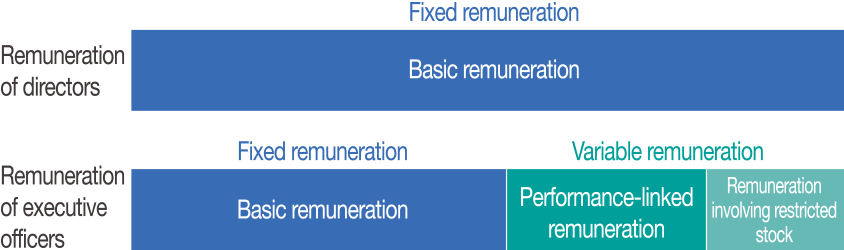
- Directors, including outside directors, receive only base remuneration as fixed remuneration, while executive officers receive base remuneration and variable remuneration consisting of performance-linked remuneration as a short-term incentive and restricted stock remuneration as a medium- to long-term incentive.
- 3)Base remuneration
- The base remuneration of executive officers is individually determined through deliberation by the Remuneration Committee in consideration of the job description, importance of job responsibilities, and career history of each executive officer, as well as the Company's dividend performance and business environment.
- 4)Performance-linked remuneration
- Performance-linked remuneration is aimed at serving as a short-term incentive for the achievement of management plans and is provided to encourage each executive officer to demonstrate their diverse abilities. It is paid at an appropriate percentage set by the Remuneration Committee based on the degree of achievement of the targets to be achieved in a single fiscal year. This remuneration varies from around 0% to 30% of the total remuneration. Calculation items include consolidated sales and operating profit margin for a single fiscal year, financial indicators important in terms of management strategies, and non-financial indicators such as environmental and human resource development indicators.
- 5)Restricted stock remuneration
- Restricted stock remuneration is paid to executive officers as an incentive to align their economic interests with those of the shareholders and increase the Group's corporate value in the medium to long term. It is granted at a fixed time each year, with the number of shares granted determined through deliberation by the Remuneration Committee based on each executive officer's job description and importance of job responsibilities, as well as the stock price level and other factors.
Risk Management
FSG has established the Group Risk Management Rules, which define its basic policy and management systems to address the various risks that may arise in the course of business. The Group Risk Management Rules not only provide for a disaster prevention system and a crime prevention and security system but also define the organizational structures and roles of the Group Risk Response Headquarter and the Regional Risk Response Headquarter as crisis management bodies in the event of an emergency, accident, or incident.
Risk management in ordinary times
In ordinary times, FSG's basic framework for risk management requires that potential risks be periodically identified and located on (regional and Group-wide) risk maps according to their level of impact on management and likelihood of realization and that systems be established to address those risks, based on the risk maps. Each year, we use risk maps to share risk awareness and constantly consider responses to these risk events (avoidance, transfer, reduction, acceptance, etc.) and implement action plans in order to improve the Group's risk responsiveness.
Risk management in times of emergency
On the other hand, in the event of an emergency (when an incident occurs), a Group Risk Response Headquarter will be established at the regional and Group levels, as needed, to ensure a swift and appropriate response across the Group.
FSG has established a Group-wide emergency contact network to ensure that in the unlikely event of a risk event or incident, it is reported to management as quickly as possible depending on the impact and importance of the risk. Business chats are currently used as the form of communication. This enables us to quickly share information and risk awareness and respond and provide instructions swiftly, regardless of where incidents occur within the Group - both domestically and internationally - and regardless of where the management team members are located.
Compliance
Fuji Seal Group (FSG) Code of Ethics
As a global firm, FSG has established and published the FSG Code of Ethics, positioning compliance, which is a prerequisite for business activities, as the most important management issue. The FSG Code of Ethics defines the universal values to be observed and followed by each director, executive officer, senior management member, and employee of FSG (hereinafter, "FSG Personnel") from a corporate ethics perspective as Ethical Standards and establishes a Code of Conduct to sincerely implement them.
Group-wide compliance management system
FSI has established the Group Compliance Committee to promote and support compliance management throughout
the Group.
The Group Compliance Committee bears responsibility for important compliance-related matters, including devising and deciding on organizations and systems related to compliance; deliberating on the revision and abolishment of provisions in the FSG Code of Ethics; developing and finalizing Group-wide compliance action plans; and monitoring the implementation of those action plans. The Committee also submits reports and deliberation requests on these matters to the Board of Directors.
To spread the values aimed at in the FSG Code of Ethics
FSG distributes Compliance Cards to all Group executives and employees for educational purposes. In FY2024, we created a video summary of the FSG Code of Ethics in the 11 languages of the countries where FSG companies are located and integrated it with our e-learning system. Additionally, we provided training to managers and other personnel on ethical conduct, diversity, equity, and inclusion (DE&I), harassment, and anti-bribery and corruption.
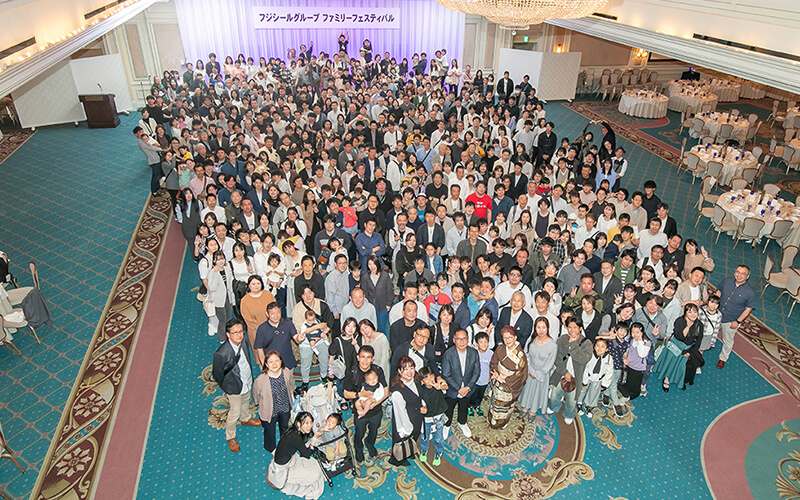
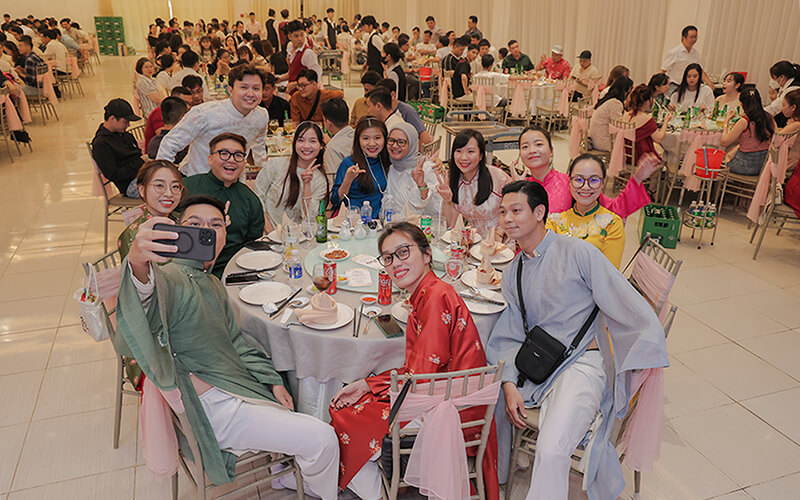
In addition to distributing Compliance Cards and holding training sessions and seminars, we engage in the following ongoing activities: raising awareness through Family Festivals and company anniversary celebrations, displaying awareness posters in workplaces, and publishing articles about compliance in our in-house newsletter.
Each year at the Family Festival, top management reminds employees of the phrase written on the Compliance Card: "Can you explain that judgment (action) of yours to your family (loved ones)?" This phrase means that the Company believes it is important to continue a style of open management that can be explained to one's family and supported by one's family.
Consultation Hotline
To detect injustices, such as human rights infringements and harassment, as well as bribery and other misconduct and compliance-related problems, as early as possible and respond appropriately and promptly to them, FSG has established a whistleblowing system, the Consultation Hotline, which allows employees to report suspected cases. The Consultation Hotline operates while ensuring complete confidentiality and preventing any disadvantageous treatment of whistleblowers. The system can also be used anonymously.
In addition, the details of reports and the status of responses are regularly reported to the Group Compliance Committee, the Board of Directors, and the Audit Committee, and are used to improve compliance and risk management throughout the Group.
Compliance Card
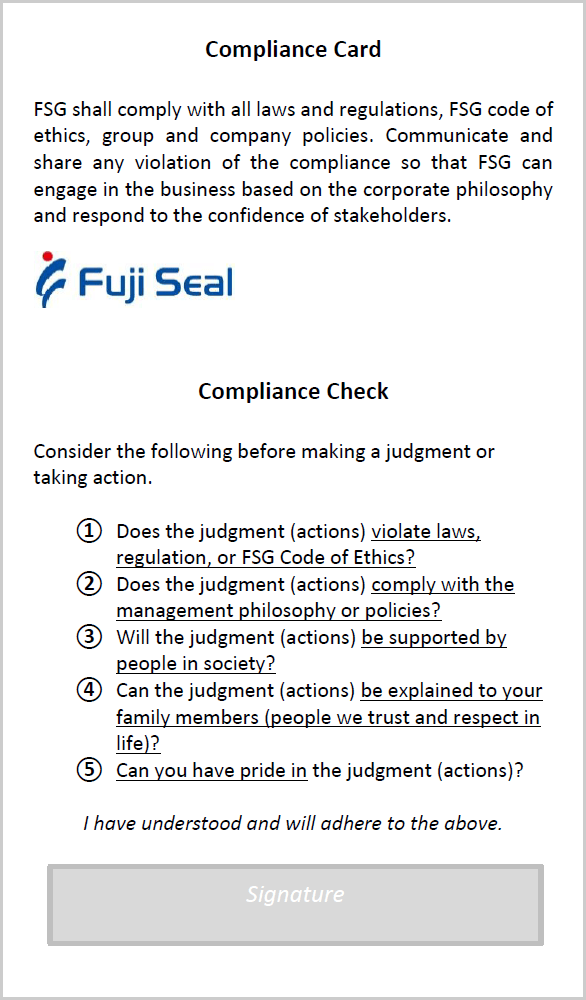
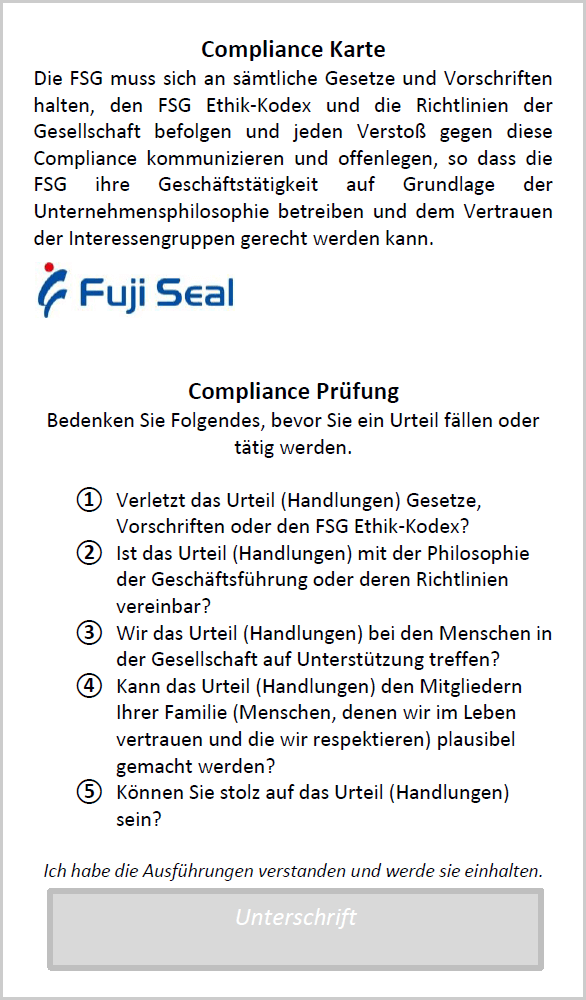
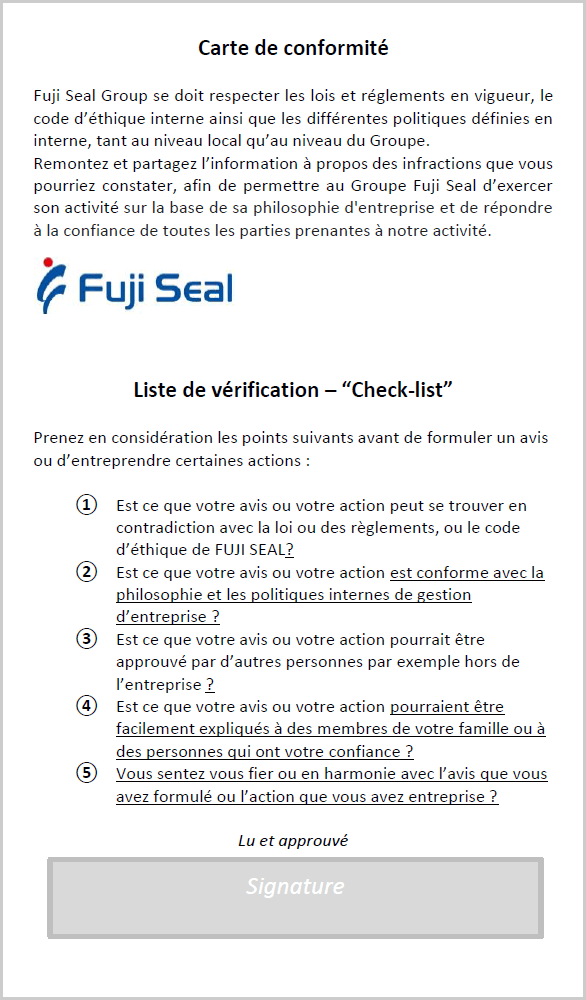
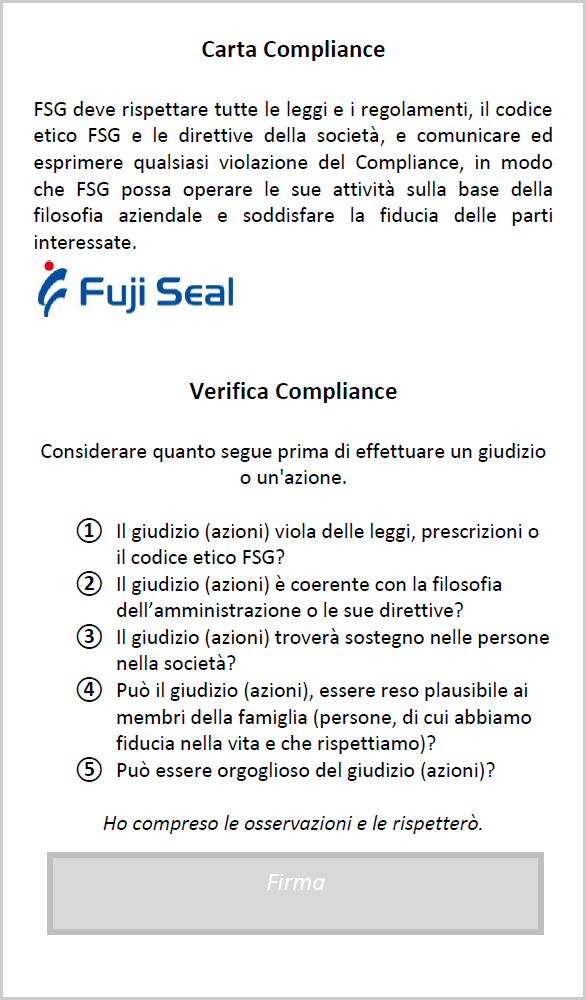
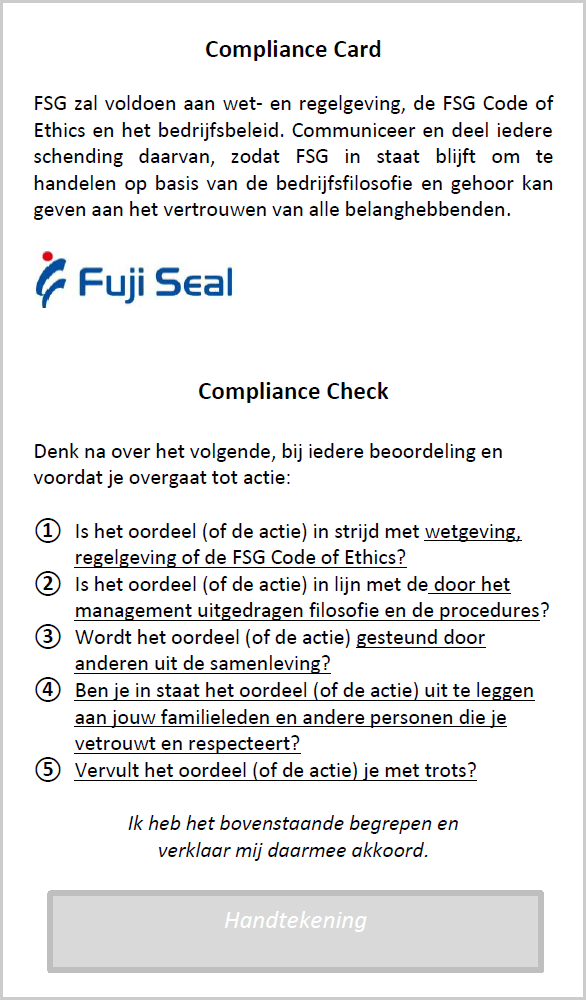
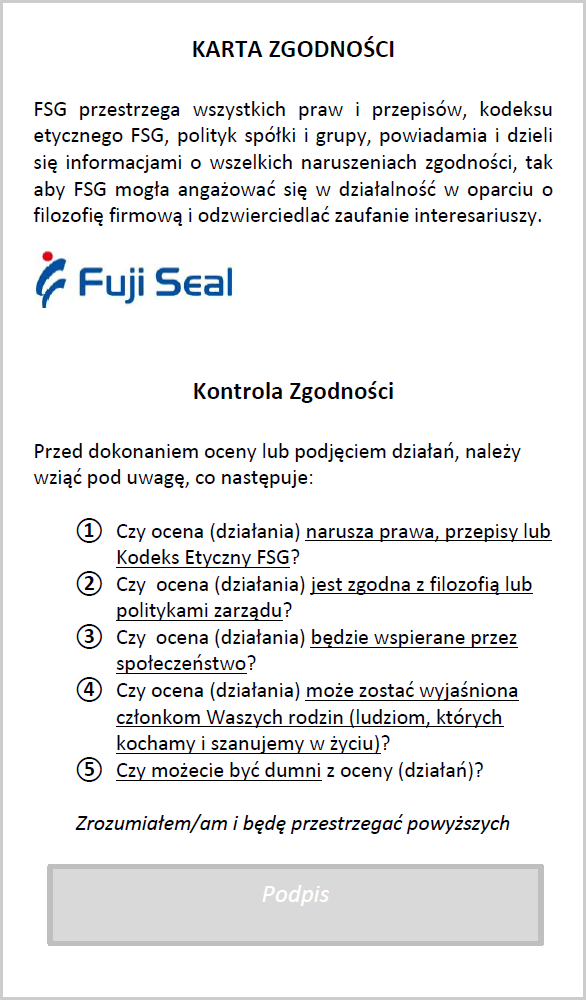
Compliance posters used in Europe



Family Festival and Foundation Day
The Company believes that the philosophy of corporate governance must penetrate not only the management team but also each employee. Awareness-raising activities are held by making the most of every possible opportunity so that employees will be able to understand the mission statement and the basic policy, and take appropriate action.
One example of such activities is the "Family Festival," which the Fuji Seal Group holds on the anniversary of the Company's foundation at each business location in Japan and the "Foundation Day Celebrations" abroad by inviting employees and their families.
This Family Festival dates back to 1985, when a festival was held concurrently with the establishment of the "Fuji Seal Employees Shareholding Association."
This festival serves as an opportunity for the employees' families to know and understand the Company's philosophy, history, products, workplaces and colleagues, not just to deepen friendships.Furthermore, the Compliance Card that employees always carry contains this phrase: "Can you explain that judgment (action) of yours to your family (loved ones)?" This phrase means that the Company believes it is important to continue a style of open management that can be explained to one's family and supported by one's family.
Family Festival and Foundation Day